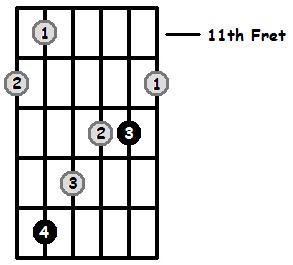
The augmented arpeggio is one of four triads (major, minor, augmented, diminished).
The augmented arpeggio contains the following:
1 – 3 – #5
It is the ‘sharp 5th’ that gives the augmented arpeggio its distinctively dissonant sound.

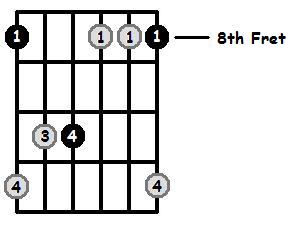
Minor arpeggios are an important part of every guitarists arsenal. If you could only ever master two arpeggios, you would most likely master major arpeggios and minor arpeggios.
If you’re not sure what arpeggios are and why they are important, read the following post, why are arpeggios important?

In this post, we are going to look at major arpeggios and the different movable positions for major arpeggios on the guitar.
Many guitarists spend a large amount of time mastering scales and often place less importance on arpeggios. This is a mistake. Arpeggios are a very important part of guitar mastery. There is no better way to ‘get inside’ the sound of a chord than by using arpeggios. Just like anything on the guitar, there is an art to using arpeggios in a musical way, but a large part of the challenge is to simply learn the shapes and be able to play them fluently.
Major arpeggios are particularly important because the major triad is arguably the ‘master chord’ in all of western music. The purpose of this post is not to delve to deeply into chord theory, but a major triad contains the 1, 3 and 5 of a major scale and all other chords can be related in someway back to a major triad.

In part 1 of How To Use Guitar Modes, we looked at using modes on the guitar over a chord progression, by finding the key centre. In summary, staying diatonic requires finding the key centre or key centres of a chord progression, and using that key centre to determine which modes go over certain chords.
In this lesson, we are going to go parallel. Going parallel refers to a concept discussed in the lesson, guitar modes explained, which looks a each mode in its own right, separate from other modes or keys. Basically, using this approach, when we see a chord, we say in theory that there are a number of modes that could be used over that chord, and it is simply a matter of taste as to which one we choose. Staying diatonic is about following rules. Going parallel is about experimenting and essentially being free.

How do you use modes? It can take a lot of practice to understand modes and be able to play the shapes fluently by memory. Once you are starting to get on top of the basics, a greater challenge beckons – Using them in a music situation. This requires a broader understanding of modes. In this two-part lesson on using modes, we are going to look at the basics of using modes over a chord progression.
There are two approaches that we are going to explore in this lesson:
Staying Diatonic
Going Parallel
Understanding and using modes on the guitar is very important. It takes many hours of practice memorizing the positions, analyzing qualities of each scale and digesting all the theory that goes with it. It’s important to realize however, that an understanding of modes is not really complete without a good understanding of how they relate to diatonic chords. Chords and scales are very closely linked and a strong understanding of chords aids the use of scales and visa versa. In this post we are going to explore how modes relate to the diatonic chords of a major scale.
Firstly, I’m assuming for the sake of this lesson, that you have a basic understanding of modes. You don’t have to be a master just yet. In fact, hopefully this lesson will help you on your way. If you don’t have at least a basic understanding of modes, please read the post, guitar modes explained. I’m also assuming that you have a basic undertstanding of chords and how they are constructed. If not, please read the post on chord construction before moving on. Assuming you know a bit about both areas, let’s explore their relationship a bit further.