Basic Intervals on Guitar – Tones And Semitones

tones semitones pic 300

In this lessons, we’re going to explore basic intervals on the guitar. This lesson will be pretty basic, but it will allow us to dive into more complex concepts, such as using intervals to build scales and unlocking the notes along the fretboard.

What Is An Interval?

An interval is really just the distance between two notes, measured in pitch. One of the advantages of the way that the guitar is set out is that it is very easy to visualise intervals. Because of the nature of using frets as reference points, it’s quite easy to relate to intervals in terms of frets. Let’s do some examples using Semitones.

Read more

The Major Blues Scale on the Guitar – CAGED Positions and Theory

Major Blues Feature 300

In this lesson, we’re going to look at the Major Blues scale. In the previous lesson, we explored the Minor Blues scale and discussed why it is arguably the most popular scale for guitarists.

The Major Blues scale is also a very useful scale, but it is not used as often as the Minor Blues scale. The Minor Blues scale seems to work over most chords including major chords and minor chords. The Major Blues however, only really works over Major chords, because it contains a ‘natural 3’, which clashes with the ‘b3’ of minor chords.

Read more

The Minor Blues Scale – The Go To Scale For Every Guitarist

Minor Blues Feature 300

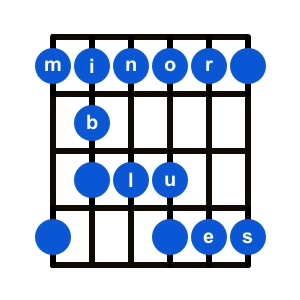
In this lesson, we’re going to look at the ‘Minor Blues Scale’.

The minor blues scale is perhaps the most popular scale for guitarists (and indeed other instrumentalists). Why? Because it can be used effectively in many different situations, it has an in-built ‘blues sound’, and it lends itself very easily to things such as bends and slides.

Read more

How To Read Scale Diagrams

Read Scales Pic 300
Read Scales Pic 300

In this lesson, we’re going to look at how to interpret scale diagrams. Scale diagrams are used a lot throughout this site, so it’s important to understand how to read them.

Before we get right into it, it’s important to understand that conventions for writing out scales do vary, depending on who is writing them out. The main point of variation being the direction in which the strings and frets are set out. Some people place the strings in the diagrams horizontally, the frets vertically and some people do the opposite.

Read more

How To Tune Your Guitar Using A Tuner

Tuner Pic Flat 250
machine heads instagram

How do you tune a guitar? If you’ve just started playing guitar, this is one of the first and most pressing questions that you will have. No matter what you are planning to play or learn on the guitar, you need your guitar to be in tune. This means that you will need to know how to tune your guitar – regularly and accurately.

How Often Should You Tune?

Beginners often think that once their guitar is in tune, they are all set for a while. This is not the case. You should get into the habit of tuning your guitar once a day, or even more. Guitar is not like a piano, where you generally only need to get it tuned once every few months. The intonation on the guitar is temperamental and is easily affected by many things – the weather, how often it’s played, the room it’s in, being transported around. It’s very easy for a guitar to go out of tune.

You need to know how to tune a guitar if you want to be a guitarist.

Read more